
Bushings vs bearings: key differences explained
Published: 2026 11 02
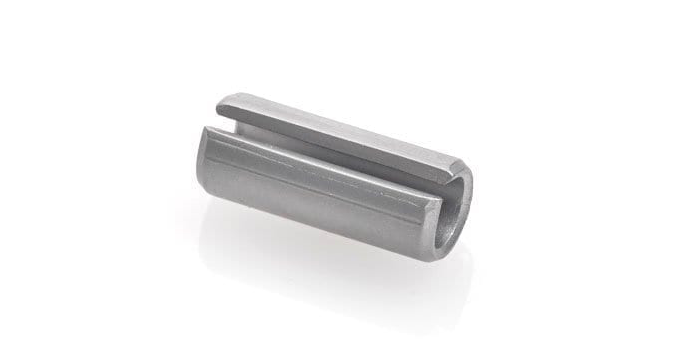
Bushings and bearings are easy to confuse. Both support moving parts and reduce friction, but they do it in different ways. A bushing is technically a type of bearing – a plain bearing. It’s a sleeve fitted between a shaft and its housing, and the shaft slides against its inner surface. A rolling element bearing places balls or rollers between two rings, so the surfaces roll rather than slide. Whether to choose a bushing or a bearing depends on load, speed, motion type, available space, maintenance requirements, and lifetime cost.
As a bushing manufacturer, Lesjöfors combines materials knowledge, precision manufacturing, and engineering support to produce custom bushings for a wide range of industrial applications. In this blog, we take an in-depth look at bushings vs bearings – how each works, where they differ, and how to choose between them.
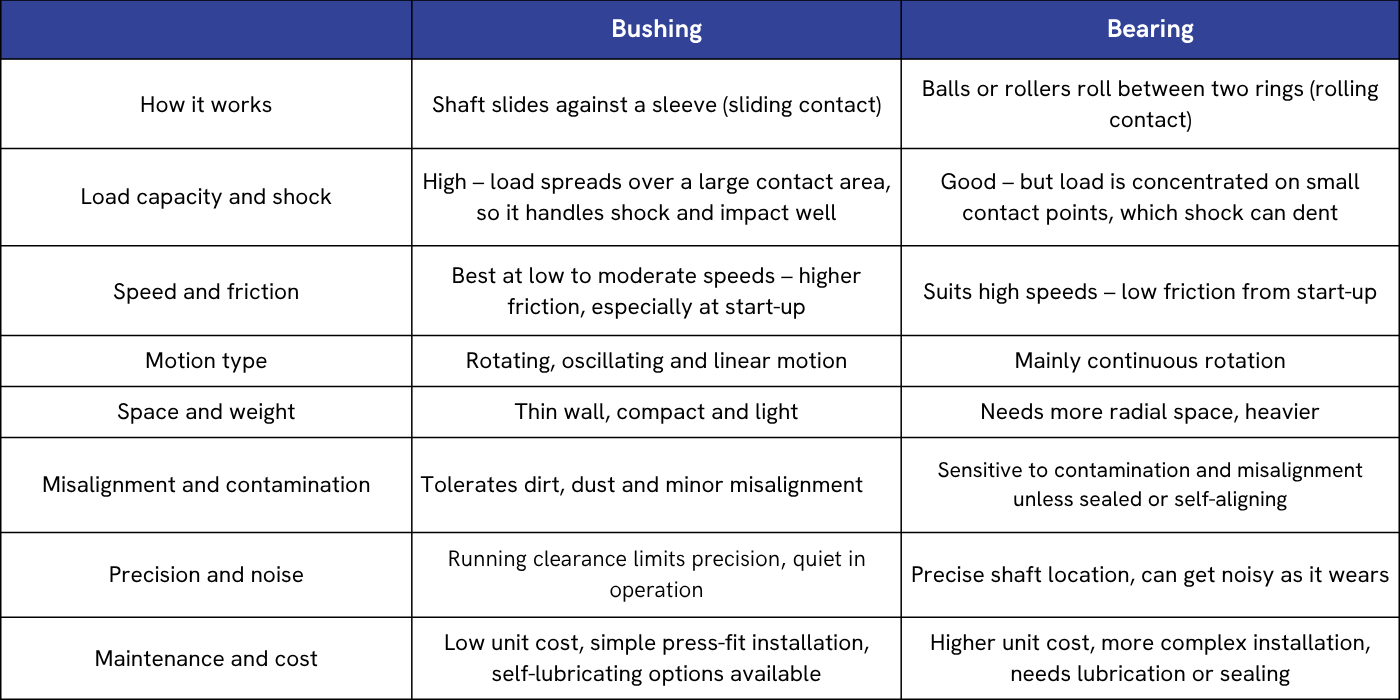
Bushing vs bearing at a glance
What is a bushing?
A bushing is a simple, low-cost sleeve designed to carry loads while reducing friction between moving parts, used everywhere from car suspensions to medical devices. For a full introduction, read the article "What is a bushing? A complete guide to bushing applications."
How a bushing works
A bushing fits inside a housing, and the shaft moves inside the bushing. The shaft slides against the bushing’s inner surface rather than rolling. A thin layer of lubricant, either applied or built into the material, keeps friction and wear low.
Bushing, sleeve bearing, or plain bearing?
You may hear bushings called sleeve bearings, bush bearings or, in some applications, journal bearings. These all describe the same basic part. Bushings belong to a broader group called plain bearings, which includes any bearing without rolling elements.
Types of bushings
At Lesjöfors, we engineer a wide range of bushings:
- Plain (sleeve) bushings: cylindrical sleeves that reduce friction under radial loads.
- Flanged bushings: designed with a flange that adds axial support and makes mounting easier.
- Grooved bushings: internal grooves distribute lubricant evenly.
- Spherical bushings: absorb misalignment and shock in suspension systems.
- Split bushings: made in two halves for simplified installation and maintenance.
- Thrust bushings and washers: designed to handle axial loads.
How bushings are made
How a bushing is made affects its cost, wall thickness, and performance. There are four main methods:
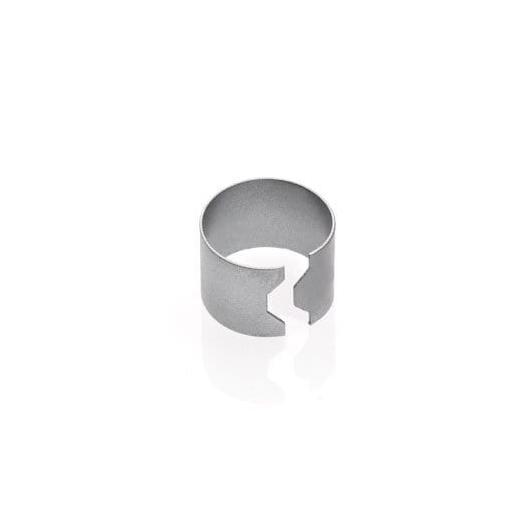
- Bent (wrapped) bushings start as a flat metal strip that is cut to length and rolled into a cylinder. This leaves a small seam, which closes when the bushing is press-fitted into its housing. It’s a fast, low-waste process, well suited to high volumes.
- Deep-drawn bushings are pressed from a flat blank into a seamless tube using a punch and die. Without a seam, they give good roundness and can be formed with a flange or closed end in the same operation.
- Machined bushings are turned from solid bar or tube. They suit thick walls, large diameters, and small batches, but take longer to produce and waste more material.
- Sintered bushings are made by compressing metal powder, usually bronze or iron, and heating it until the particles bond. The porous structure can be filled with oil, which makes the bushing self-lubricating.
What is a bearing?
In the bushing vs bearing comparison, “bearing” usually means a rolling element bearing. Instead of sliding, the shaft is supported on balls or rollers that roll between two rings.
How rolling element bearings work
A rolling element bearing has four main parts: an inner ring, an outer ring, a set of balls or rollers, and a cage that keeps them evenly spaced. The inner ring usually fits on the shaft and the outer ring sits in the housing. As the shaft turns, the balls or rollers roll along tracks in both rings.
Common bearing types
- Ball bearings: the most common type, suited to high speeds and moderate loads.
- Cylindrical roller bearings: rollers instead of balls, for heavier radial loads.
- Tapered roller bearings: handle radial and axial loads together, as in vehicle wheel hubs.
- Needle roller bearings: long, thin rollers that give high load capacity in a small radial space – often the closest alternative to a bushing.
- Thrust bearings: a bearing designed for axial loads along the shaft.
Key differences between bushings and bearings
Load capacity and shock loading
Bushings spread load across their whole inner surface, so they handle high static loads and shock better than bearings, where load is concentrated on small contact points. A sudden impact can dent a bearing’s raceways and cause early failure. That’s why bushings are common in suspension systems and heavy-duty equipment, while bearings perform best under steady loads.
Speed, friction and stick-slip
Bearings have lower starting friction and handle high continuous speeds well. Bushings suit low to moderate speeds because sliding friction builds heat at high speed and wears the bushing faster.
At very low speeds, some bushings can suffer from stick-slip, where the shaft sticks and then jumps forward, causing jerky movement or squeaking. Low-friction materials such as PTFE and good lubrication help prevent it.
Motion type: rotating, oscillating, and linear
Bearings work best in continuous rotation. In small back-and-forth movements, the rolling elements don’t travel far enough to spread the lubricant, which causes wear marks on the raceways known as false brinelling. Bushings handle pivots, hinges, and oscillation well. They also work as guides for linear motion on sliding shafts, while linear ball bearings suit applications that need very low friction or high precision.
Space and weight
Thin-wall bushings take up far less radial space than a bearing with two rings and rolling elements, and fewer parts means less weight. For this reason, bushings are often the better choice where space and weight are limited, such as handheld devices, automotive assemblies, and aerospace components. Pressed bushings can have walls as thin as 0.2 mm.
Misalignment, contamination, and harsh environments
Standard rolling bearings are sensitive to misalignment unless a self-aligning type is used. Bushings tolerate minor misalignment, and spherical bushings are designed to absorb it. Bushings also cope better with dirt, water, and corrosion because there are no rolling elements for particles to jam or damage. With the right material, such as bronze, stainless steel, or polymer, they’re a reliable choice for marine and offshore applications, renewable energy infrastructure, and agricultural equipment.
Precision, noise, and vibration
Bearings are generally more precise because they run with little or no internal clearance, resulting in lower shaft runout. A bushing must leave a slight gap around the shaft for the lubricant film, so it can’t hold the shaft as precisely. But with no rolling elements, bushings are generally quieter, especially at low speeds, and they damp vibration rather than pass it on. Bearing noise tends to rise with speed and wear.
Maintenance and total cost of ownership
Bushings have a low unit cost and are simple to install, often just pressed into place. Self-lubricating types need little or no maintenance over their service life, and wear is gradual and predictable, meaning replacement can be planned. Bearings cost more and need more careful installation. Open bearings need regular lubrication, while sealed bearings cost more upfront, and bearing failure can occur suddenly and damage surrounding parts.
When to use a bushing instead of a bearing
Bushings are the better choice for high loads or shock loads, slow or oscillating movement, tight spaces and harsh conditions:
- Suspension and steering linkages: constant shock and pivoting would damage a bearing. Bushings absorb impacts and damp vibration.
- Hydraulic cylinders: rods face heavy side loads and short strokes. Hydraulic cylinder bushings guide the rod and resist wear in a compact space.
- Hospital beds and surgical tools: medical equipment needs quiet, compact, low-maintenance parts. Self-lubricating bushings avoid grease contamination and withstand sterilization.
- Landing gear pivots: aerospace landing gear takes extreme impact loads within strict space and weight limits. Bushings handle the shock in a light, compact package.
- Hinges, agricultural equipment, and solar trackers: slow pivoting and outdoor exposure challenge bearings. Corrosion-resistant, self-lubricating bushings handle dirt and weather with little maintenance.

When a bearing is the better choice
A rolling element bearing is usually the better choice for:
- High-speed continuous rotation: electric motors, fans, and pumps run at speeds that would overheat a bushing. Bearings keep friction and heat low.
- Low starting torque: bearings need very little force to start turning, which helps equipment that stops and starts frequently or has limited power.
- Precise shaft positioning: machine tool spindles, gearboxes, and instruments need minimal play. Bearings locate the shaft more accurately than a bushing with running clearance.
- Light loads at high RPM: where loads are steady and speeds are high, bearings deliver long, efficient service.
How to choose: a selection checklist
Work through these questions to narrow down the right component:
- Motion: is it continuous rotation, oscillating, pivoting, or linear?
- Speed: how fast does the shaft turn or slide?
- Load: how heavy is it, and does it include impact?
- Space: how much radial space and weight can the design allow?
- Environment: will it face dirt, water, chemicals, or extreme temperatures?
- Precision: how accurately must the shaft be located?
- Maintenance: can it be lubricated, or must it run maintenance-free?
- Volume: how many parts do you need, and at what target cost?
If the answers point to a bushing, check the PV value and choose the material.
Checking the PV value
The PV value combines pressure (P) and sliding speed (V) to show whether a bushing can handle the application without overheating or wearing too quickly.
- P (N/mm²) = load ÷ (bore diameter × bushing length)
- V (m/s) = π × bore diameter (mm) × shaft speed (rpm) ÷ 60,000
- PV (N/mm² × m/s) = P × V
Matching bushing material to the application
- Bronze: strong and wear-resistant, good for heavy and shock loads.
- Steel and stainless steel: high strength, with stainless adding corrosion resistance.
- Sintered bronze or iron: oil-impregnated and self-lubricating, ideal for moderate loads and speeds.
- PTFE-lined: very low friction, runs dry, and reduces stick-slip.
- Polymers (nylon, PEEK, UHMWPE): light, quiet, and corrosion-resistant, but with lower load and temperature limits, except for PEEK.
Custom bushings from Lesjöfors
To sum up, bushings suit high-load, low-speed, oscillating, or compact designs, while bearings suit high-speed continuous rotation and precise shaft location.
When a bushing is the right choice, Lesjöfors can engineer it to your specific application. We produce thin-wall bent and deep-drawn bushings, including flanged and grooved designs, in both small batches and large-scale production. Our engineers help you assess load, speed, and environment to choose the right material and design. All of it is backed by ISO 9001, ISO 14001, and ISO 45001 certification.
Explore our bushings range or contact us to request a customized solution.