
What is marine-grade stainless steel? 304 vs 316
Published: 2026 08 14
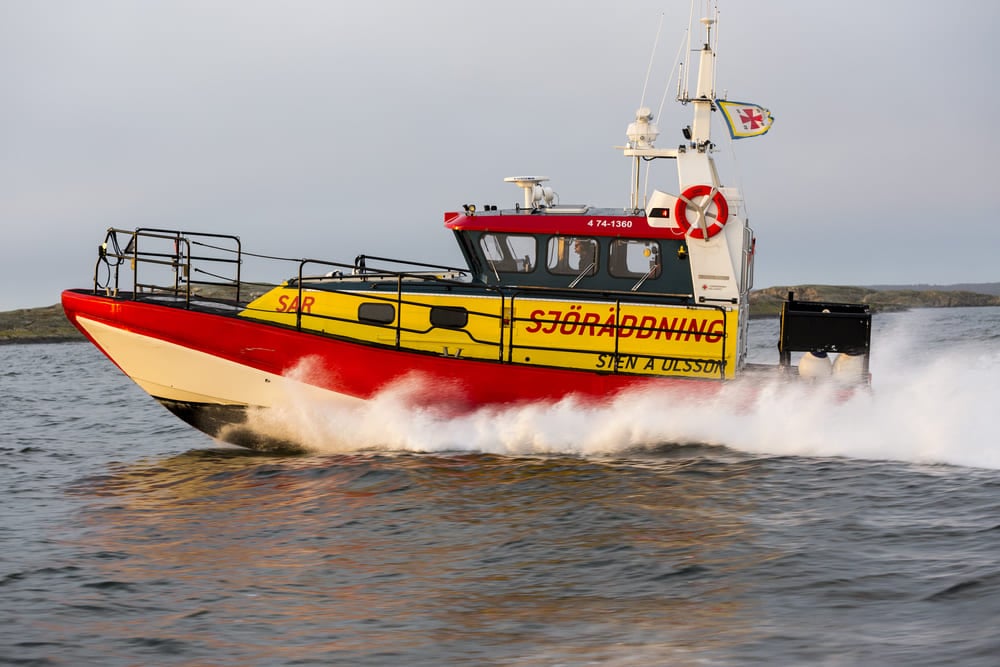
Marine-grade stainless steel is specially formulated to resist corrosion in saltwater, coastal or high-humidity environments. Choosing a material that's specially designed for marine applications is critical, as standard stainless steel is prone to corrosion in chloride-rich atmospheres. Perfect for applications such as boats and offshore infrastructure, the most common type of marine-grade stainless steel is 316.
At Lesjöfors, we work with corrosion-resistant stainless steel, producing a range of components used across the marine industry, and our products are trusted by leading boatbuilders and rescue organizations. In this blog, we'll compare stainless steel grades 316 and 304, breaking down their properties and applications.
What makes stainless steel marine grade?
The role of chromium, nickel, and molybdenum
As with all stainless steel, marine grade contains chromium, which reacts with oxygen to form a passive oxide layer on the surface – a self-healing barrier that gives the material its corrosion resistance. It also contains nickel to stabilize the austenitic structure, improving strength and formability. On top of this, marine-grade stainless steel 316 contains 2–3% molybdenum, which dramatically improves the material's resistance to chloride attack.
Engineers often compare grades using the pitting resistance equivalent number (PREN), a formula weighing chromium, molybdenum and nitrogen content. The higher the PREN, the better the resistance to localized corrosion in saltwater.
Resistance to pitting and crevice corrosion in saltwater
In marine environments, chlorides cause the biggest problems. They gradually break down the protective passive layer, and eventually pitting – localized holes in the surface – can form, compromising material strength and leading to component failure.
Crevice corrosion can also occur in tight gaps such as under washers, in fastener threads and between spring coils. And the risk isn't limited to parts submerged in saltwater; salt spray and even coastal air can cause rapid corrosion.
304 vs 316 stainless steel – what's the difference?
Composition and corrosion resistance compared
Grades 304 and 316 are the two most widely used stainless steels, and at a glance they look identical. Both are austenitic, non-magnetic when annealed, and safe for food contact. The difference lies in how they perform when chlorides enter the picture. Typical compositions under ASTM A240, the international standard covering these grades:
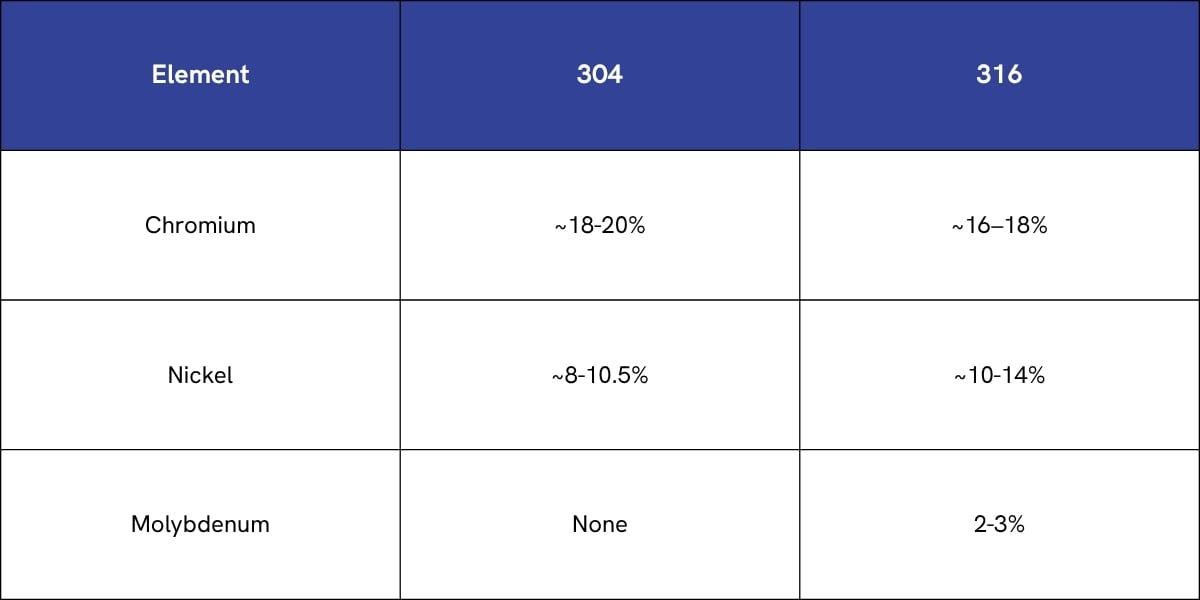
Typical compositions under ASTM A240, the international standard covering these grades: The key difference is molybdenum – present in 316, absent from 304. As covered above, it's this addition that protects against chloride attack, which is why 316 is the standard choice for marine applications, while 304 is better suited to indoor or freshwater use.
This performance comes at a price – 316 typically costs 20–30% more than 304. For components exposed to seawater or salt spray, however, the premium is far cheaper than replacing corroded parts or dealing with component failure at sea.
Is 304 stainless steel suitable for marine environments?
No – 304 stainless steel is not considered marine grade. Without molybdenum, it will gradually pit and stain when exposed to saltwater or coastal air. It remains a good choice for freshwater applications and interior cabin fittings, where chlorides aren't a factor. But if your application is in a coastal area or will have any saltwater contact, marine-grade 316 is the better solution.

316 vs 316L and A4 equivalents
Grade 316L is a low-carbon version of 316 and is also considered marine-grade stainless steel. The lower carbon content prevents sensitization – a weakening of corrosion resistance that can occur along weld lines – making 316L the preferred choice for welded marine structures and fittings.
You may also see A4 stainless steel specified, particularly for bolts and fixings. A4 is the same as 316, but simply named differently depending on the standard used (A4 is ISO, and 316 is AISI); both offer the same marine-grade corrosion resistance.
For the most extreme environments – such as components permanently submerged in seawater – duplex and super austenitic stainless steels offer even higher pitting resistance, though for most marine applications 316 is more than sufficient.
Key properties of marine-grade stainless steel
Marine-grade stainless steel combines several properties that make it the default choice for saltwater and coastal applications:
- Corrosion and pitting resistance – the molybdenum content protects against chloride attack, even in permanent saltwater contact.
- High tensile strength – retained across a wide temperature range, from sub-zero conditions to engine compartments.
- Excellent formability and weldability – 316 can be pressed, stamped, coiled and welded without losing its protective properties (316L for heavily welded parts).
- Hygienic and easy to clean – a non-porous surface that withstands washdowns, which is why the same grades serve food processing and medical applications.
- Lasting aesthetic finish – resists staining and tea-staining, keeping visible deck hardware and fittings looking sharp.
- Non-magnetic in annealed condition – useful near compasses and sensitive navigation equipment.
- Work-hardening behavior – the material strengthens as it's formed, which is put to deliberate use in components such as springs, where cold working increases load-bearing capacity.
Where is marine-grade stainless steel used?
From superyachts to fishing vessels and offshore platforms, marine-grade stainless steel appears wherever components need to perform reliably in saltwater. Below are some of the most common applications:
Boat hatches, deck hardware, and fittings
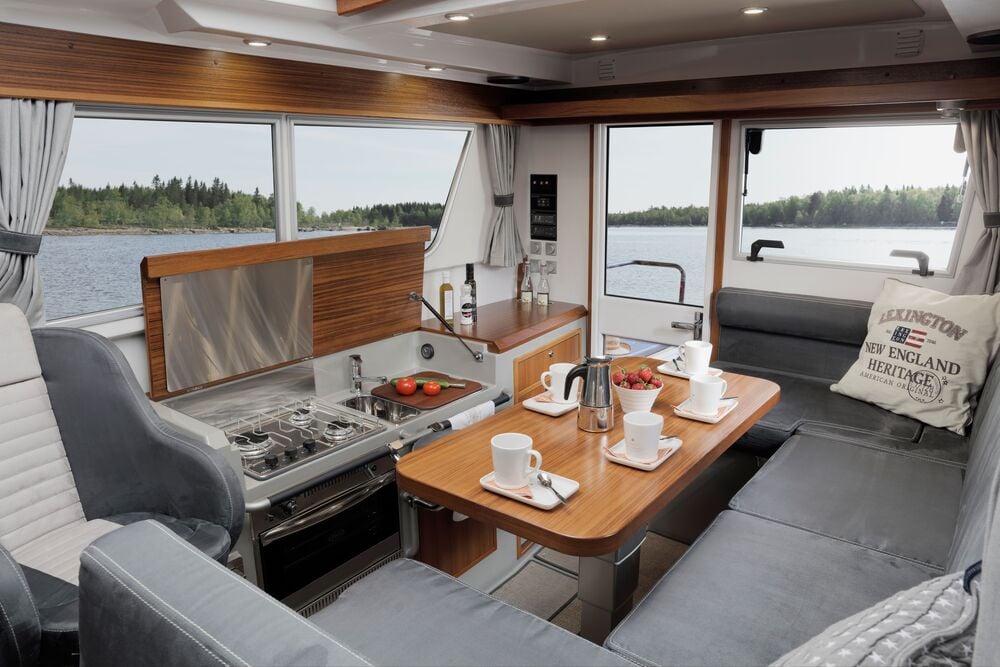
The most visible uses are on deck: railings, cleats, hinges, latches, fasteners and trim are all typically made from 316 or A4 stainless steel. These parts face constant salt spray and sun exposure, so both corrosion resistance and lasting finish matter. The same applies below deck to galley fittings and hardware in humid cabin spaces. For a full breakdown of the components involved, see our guide to the parts of a boat.
Gas springs and torsion springs in marine applications
Springs work harder at sea than almost anywhere else. Stainless steel gas springs provide controlled lifting and holding for boat hatches, engine covers and seat lockers – and have even been specified by rescue organizations for lifeboat applications. Torsion springs, meanwhile, are used in cabin hatches, hinged fittings and latching mechanisms, where their work-hardened strength and 316's corrosion resistance keep them cycling reliably for years.
Stamped and pressed marine components
Beyond springs, marine-grade stainless steel is pressed and stamped into brackets, clips, covers and custom precision parts. Stamping in 316 requires careful tooling and process control – the material work-hardens as it's formed – but done well, it produces durable, repeatable components at volume for boatbuilders and marine equipment manufacturers.
How to choose the right grade for your application
The decision usually comes down to exposure. If a component will see saltwater contact, salt spray or coastal air, specify 316 (or A4 fasteners) – the premium over 304 is small compared to the cost of replacing corroded parts. If the part will be welded, choose 316L. Reserve 304 for freshwater use and interior fittings well away from chlorides, and consider duplex grades only for extreme conditions such as permanent submersion in warm seawater. When in doubt, component suppliers like Lesjöfors can advise on what grade best suits the operating environment, based on exposure, temperature and load requirements.
Marine-grade stainless steel components from Lesjöfors
At Lesjöfors, we manufacture marine-grade stainless steel components trusted by boatbuilders, marine equipment manufacturers and rescue organizations worldwide. Our range includes gas springs for hatches and covers, torsion springs for cabin hatches and latching mechanisms, and stamped and pressed components produced to precise specifications.
Whether you're specifying parts for a new build or replacing corroded components, our engineers can help you select the right material and design for your application – get in touch to discuss your requirements.