
The secret role of clock springs in cars: key functions explained
Published: 2026 09 10

A car clock spring is one of those components most drivers never see, yet it sits behind the steering wheel of virtually every modern vehicle, keeping the airbag, horn, and steering controls connected through every turn. A wheel that never stops turning can't be hardwired. That's what the clock spring, also called a spiral torsion spring, is there to solve.
At Lesjöfors, we are a market leader in precision springs and pressings for the automotive industry at both OEM and aftermarket levels. We have designed custom clock springs to solve engineering challenges across automotive applications.
In this article, we take you through the small but fundamental role clock springs play in cars, how to spot the signs of component failure, and considerations for OEMs at the design stage.
What is a clock spring in a car?
A clock spring in a car is a coiled ribbon of conductive material housed in a rotary cassette between the steering wheel and the steering column. Its job is to maintain a continuous electrical connection between the vehicle's wiring and the components mounted on the wheel itself — most critically, the steering wheel airbag.
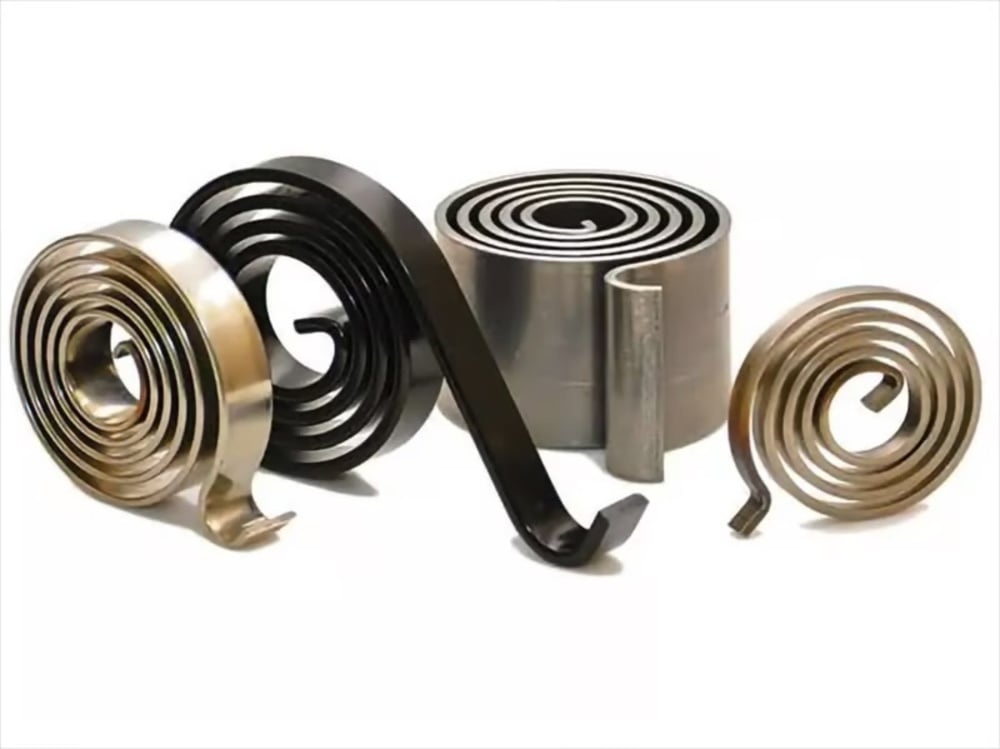
The name comes from the mainspring in traditional clockwork, where a wound strip of spring steel drives the movement. For the broader story of how these springs work across industries, see our guide to what clock springs are.
Because a driver needs to turn the steering wheel several full turns lock to lock, a fixed wire would twist and snap. The clock spring solves this by winding and unwinding with the wheel, keeping circuits unbroken through every rotation.
Maintaining the airbag electrical connection
The clock spring's most critical role is safety. The driver's airbag is mounted in the center of the steering wheel, and its igniter circuit runs through the clock spring. If that circuit is broken, the airbag cannot deploy in a collision.
The connection must survive hundreds of thousands of steering rotations over a vehicle's lifetime, remaining stable through vibration and temperature extremes and delivering current instantly in the milliseconds that matter.
Powering steering wheel buttons, horn, and cruise control
Airbag deployment may be the most critical function, but it is not the only one that relies on the clock spring's constant connection. The horn needs an unbroken circuit to alert other drivers. Audio and infotainment buttons let drivers adjust settings without taking their hands off the wheel. Cruise control, paddle shifters, and driver-assistance controls all route through the same coiled cable, as do comfort features like heated steering wheels.

How does a car clock spring work?
A car clock spring works by letting a coiled ribbon of flat conductive cable wind and unwind as the steering wheel turns, so the circuits it carries are never stretched, twisted, or broken.
Inside the cassette, the ribbon is coiled with deliberate slack in both directions. One end is fixed to the hub that rotates with the wheel, and the other to the stationary steering column. Turn left, and the coil winds tighter; turn right, and it relaxes. With most steering systems rotating two to three full turns lock to lock, the cable is sized to cover the full range with margin to spare, and the coil must be centered for equal travel in both directions.
While most spiral torsion springs store and release rotational energy, the clock spring function in a car is electrical continuity, cycle after cycle.
Signs of a bad clock spring
After years of constant winding and unwinding, a clock spring can wear, crack, or lose contact. Because the damage is hidden inside the cassette, failure usually announces itself through symptoms elsewhere. Here are the telltale signs.
Airbag warning light on the dashboard
The most common and most serious warning sign. The airbag system continuously monitors the igniter circuit that runs through the clock spring. The moment it detects a break or resistance fault, the warning light illuminates and the system may deactivate the airbag entirely. This is a genuine safety risk. A vehicle showing this fault should be inspected immediately.
Horn, buttons, or cruise control not responding
Total failure of these functions can point to a blown fuse, but intermittent failure is likely to indicate a clock spring issue. A worn ribbon cable may lose contact only at certain steering angles, so the horn works with the wheel straight but cuts out mid-turn. If faults come and go as the wheel moves, the clock spring is the prime suspect.
Clicking or grinding noise when turning the wheel
Not every symptom is electrical. A snapped ribbon or damaged cassette can produce an audible clicking, rubbing, or grinding from behind the steering wheel as loose material catches during rotation. Any new noise from the steering column is worth investigating before it becomes a connection failure.
Can you drive with a broken clock spring?
Technically, yes, a car will drive with a broken clock spring, but driving with one is strongly advised against. A failed clock spring can disable the driver's airbag and can cut out the horn – both essential safety systems.
Clock spring replacement: what's involved
Because the clock spring sits directly behind the driver's airbag, replacement is a job for an approved repairer, mechanic, or engineer rather than a DIY task. The process involves disconnecting the battery and allowing the system to fully discharge, removing the airbag module and steering wheel, and then fitting and centering the new clock spring assembly before everything is reinstalled and the system checked for fault codes.
Why correct centering matters during installation
Centering is the step that decides whether a new clock spring lasts for years or fails within days. The ribbon cable inside the cassette has a finite amount of travel in each direction. Only when the clock spring is installed at its center point, with the wheels straight ahead, is that travel shared equally between left and right lock. If the clock spring is fitted off-center, the cable will run out of slack before the wheel reaches full lock, and the ribbon will tear or snap, often taking the airbag circuit with it.
Clock springs in automotive manufacturing
For OEMs, the clock spring is a design challenge, engineered into a vehicle long before the first one is built.
Modern clock springs are precision assemblies, and the demands on them are rising. From adaptive cruise to heated rims, every new wheel-mounted function means more circuits routed through the same rotating joint. At the same time, steering column packaging is getting tighter as columns absorb more technology of their own. The result is a component that must carry more in less space without compromising cycle life.
Design and material considerations for OEMs
A clock spring is expected to survive hundreds of thousands of steering rotations, with zero interruption to a safety-critical circuit. Getting that balance right is where spring engineering expertise earns its place at the design stage.
Material selection
Material selection dictates performance. Typical choices include 301 and 302 stainless steel and 1074/1095 cold-rolled high-carbon steel – grades chosen for the combination of flexibility and fatigue resistance. Stainless and specialty alloys like Inconel serve designs exposed to heat, moisture, or corrosive environments.
Spring design
Geometry is the other half of the equation. Coil diameter, ribbon width, and the number of windings all have to be balanced against the steering system's lock-to-lock range and the space available in the column. Too little slack and the cable strains at full lock. Too much and the coil can fold, rub, or generate noise. Every design is a packaging negotiation between electrical capacity, rotational travel, and physical envelope.
These trade-offs are best resolved at the design stage. As an experienced spring manufacturer, Lesjöfors’ expert engineers are well placed to work through these challenges, creating a component that meets the performance and cycle life demands of the application.
OEM-grade clock springs from Lesjöfors
At Lesjöfors, we design and manufacture clock springs for precision-controlled motion in demanding applications, including the automotive industry, at both OEM and aftermarket levels.
Our teams work with OEM designers to define the torque range, rotation angle, material, and mounting style a specific application demands, resolving the trade-offs between electrical capacity, packaging, and cycle life at the design stage. From there, advanced forming and heat treatment processes with precision winding and tension control deliver the fatigue strength and dimensional accuracy that the component requires.
Whether you're specifying a component for a new steering system or sourcing a proven spring for an existing platform, our global engineering team and distribution network can help you find the right solution.
Explore our clock spring range or request a customized solution.