
What is a disc spring? Types, materials & applications
Publicerad: 2026 07 20
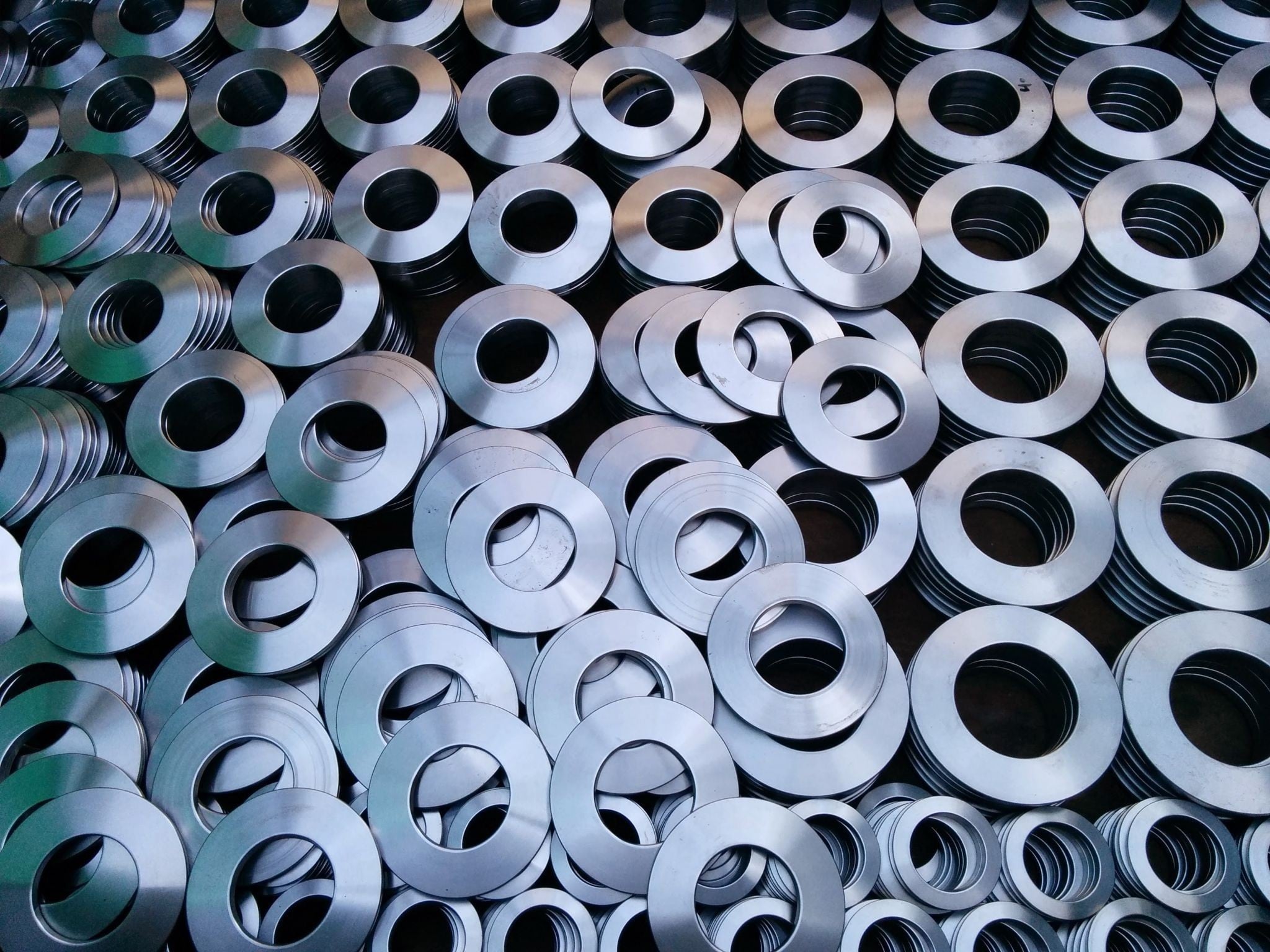
From automotive clutches to valve actuation systems, disc springs – or Belleville springs as they are also known – provide high load capacity within minimal space. But what exactly is a disc spring?
At Lesjöfors, we manufacture disc springs to stock and custom specifications, supplying engineers and procurement teams across industries. In this guide, we'll explain what a disc spring is, how it works, and where it's used.
What is a disc spring?
A disc spring by definition is a washer with a conical profile that deflects axially under load, generating a controlled spring force. This type of spring delivers high force within a small footprint, so it is well-suited to applications where space and weight are at a premium.
Disc springs are also known as Belleville springs, after French engineer Julien Belleville, who patented the design in 1867. The two terms refer to the same component and are used interchangeably.
How does a disc spring work?
Disc springs explained
When a Bellevelle spring is compressed, its conical spring geometry converts axial force into a controlled spring load. The result is high force output from minimal deflection – ideal for applications with tight space constraints. This load-deflection relationship is non-linear but predictable, calculated in accordance with DIN EN 16984.
Load-deflection characteristics
The relationship between load and deflection in a disc spring is determined by its geometry – the cone angle, thickness, and diameter all influence how the spring responds under compression. Depending on the ratio of cone height to material thickness, the load-deflection curve can be progressive, linear, or regressive. This tunability allows engineers to design a Belleville spring with a predictable, repeatable load curve.
Stacking in series and parallel
Stacking modifies the behavior of individual disc springs: series stacks extend travel, parallel increases load capacity, and combinations of both allow engineers to fine-tune performance for specific conditions. This adaptability, combined with consistent load distribution under dynamic and extreme operating conditions, is central to why disc springs appear across such a wide range of applications.

Advantages of disc springs
Unlike conventional coil springs, disc springs offer compact, high force – a critical advantage in applications where space and access are limited. Their load-deflection curve is tunable, so they are widely used in high-precision applications where force control matters.
Under dynamic loading conditions, disc springs absorb and release energy efficiently, maintaining consistent performance across repeat cycles. This gives them strong fatigue resistance and a long service life – particularly relevant in automotive, aerospace, and heavy machinery applications where reliability under sustained load is non-negotiable.
Their geometry also accommodates thermal expansion, wear, and mechanical relaxation without loss of function.
Types of disc springs
Disc springs can be used in various configurations depending on the application requirements.
Single disc springs
Using springs individually is the most common configuration, providing precise load over a short deflection range. Single disc springs are ideal for high-load, limited-space applications.
Series stacks
When greater deflection is needed without increasing force, a number of disc springs can be stacked in series – arranged in alternating orientations to extend travel while maintaining the same load as a single spring.
Parallel stacks
Stacking disc springs in parallel – in the same orientation – increases load capacity while keeping deflection equivalent to a single component. This configuration suits heavy-duty, high-force applications.
Combination stacks
Combining series and parallel stacks allows engineers to fine-tune both load and deflection for specialized applications.
Slotted disc springs
Slotted springs feature radial slots, which modify the load-deflection curve and reduce stiffness. These are well-suited to applications requiring controlled flexibility and a softer spring rate.
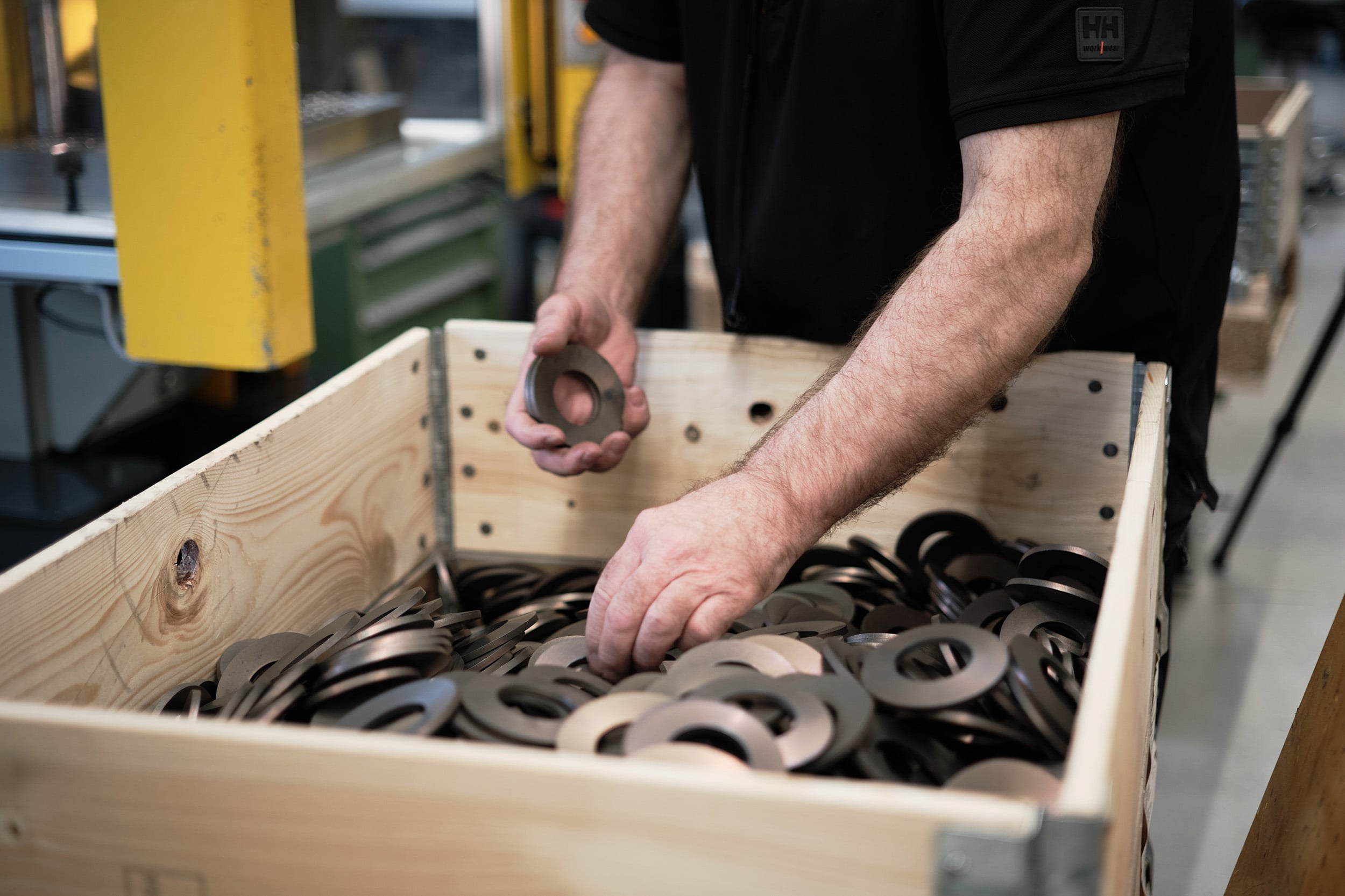
Disc spring materials
Spring steel
Spring steel is a common material choice, as it offers high strength, fatigue resistance and cost efficiency.
Stainless steel
For environments with high humidity, corrosive agents, or extreme temperatures, stainless steel provides reliable corrosion resistance without compromising load performance.
Super alloys
In highly demanding environments such as aerospace, offshore, and power generation, super alloys such as Inconel deliver exceptional resistance to heat, oxidation, and wear – maintaining performance where standard spring steels would degrade.
Where are disc springs used?
Automotive systems
Disc springs are common across automotive systems. Maintaining tension and absorbing vibrations within a compact space, they are used in clutch assemblies, braking systems and valve actuation.
Heavy machinery
In heavy machinery, Belleville springs manage high loads and control vibration in equipment that operates under sustained stress. They offer fatigue resistance and consistent load distribution in demanding industrial environments.
Renewable energy
Within the renewable energy sector, disc springs feature in wind turbines managing extreme loads, vibration, and fatigue in onshore and offshore environments, where corrosion resistance is also a requirement.
Electronics
Disc springs provide stable contact pressure and compact load control within electronic components like switches and satellite systems.
Precision disc springs from Lesjöfors
Engineered for high load performance within minimal space, disc springs are trusted across automotive, industrial, and energy applications worldwide. At Lesjöfors, we supply stock Belleville springs and custom spring designs – from standard spring steel through to super alloys for the most demanding environments.
With thicknesses from 0.10 to 12 mm, outer diameters up to 500 mm, and ISO-certified production, we have the range and engineering expertise to meet almost any requirements.