
How do lockable gas springs work? Mechanism explained
Publicerad: 2026 07 03
Some applications demand more than smooth, free movement – they need controlled, secure positioning under load. Lockable gas springs – or lockable gas struts as they are also known – provide safe, precise positioning in applications across automotive, medical, industrial machinery, and beyond.
At Lesjöfors, we supply one of the industry's largest ranges of stock locking gas springs, as well as custom-design solutions to meet specific client requirements. In this blog, we explore exactly how a lockable gas spring mechanism works and how to choose the right one for your application.
What is a lockable gas spring?
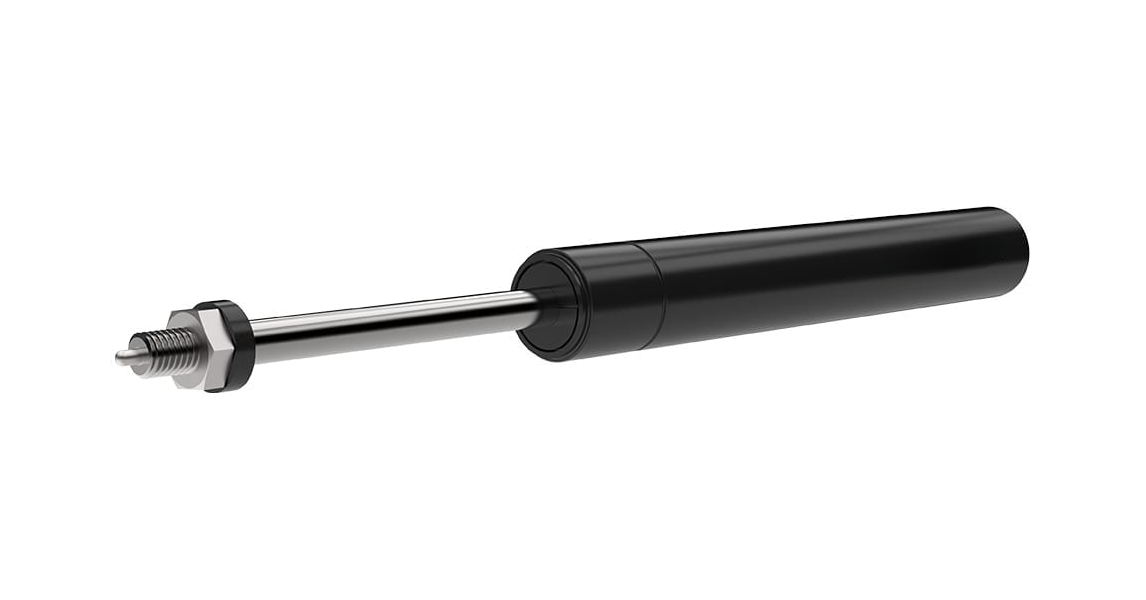
Lockable gas springs are designed to hold the piston rod securely at any point along its stroke, without the need for external locks or mechanical stops. Unlike standard compression gas springs, which move freely through their travel, lockable gas springs incorporate an internal locking mechanism that enables smooth adjustment and secure load holding in a single, self-contained unit.
How does the locking mechanism work?
Core components
A lockable gas strut comprises a pressure-rated cylinder, a precision-machined piston and rod, high-performance polymer seals, and an internal locking valve. The piston rod is typically chrome-plated or black nitrided for wear resistance and corrosion protection. Together, these components work under the force of compressed nitrogen to enable both smooth movement and secure positioning.
The locking principle
Lockable gas springs operate by harnessing the pressure of compressed nitrogen alongside an internal valve-controlled locking mechanism. As the piston rod is moved, the valve regulates the separation of gas and oil chambers, allowing the rod to travel smoothly. When the release mechanism is disengaged, the valve closes, and the rod locks firmly in place, holding its position securely under load.
Rigid vs. elastic locking
Lockable gas springs are typically available in rigid and elastic designs. A rigid mechanism locks the piston firmly in place, making it the preferred choice where secure, fixed positioning is the priority. An elastic mechanism locks the piston while allowing a slight degree of cushioned movement under load. It’s well-suited to ergonomic furniture and patient care products where comfort is also a factor.
How is a lockable gas spring activated?
Common actuation methods
When it comes to actuation and release, lockable gas springs typically use one of three mechanisms.
- Push-button actuation is the most common method. Pressing the pin or button releases the lock, allowing the rod to move freely. Releasing it relocks the spring in position.
- Cable actuation is used for remote or hands-free operation, making it well-suited to hard-to-reach assemblies where direct access to the spring is limited.
- Lever or trigger actuation is common in industrial and heavy-duty settings, where a mechanical lever releases the lock for manual repositioning.
The actuation method affects integration requirements, so it’s important to establish which mechanism is needed during the initial design stages. At Lesjöfors, our engineers can advise on the best option for your application and requirements.
Types of lockable gas springs
At Lesjöfors, we manufacture three main types of lockable gas springs, each engineered to meet different positioning and load-holding requirements.
Rigid locking on extension
Extension-locking gas springs hold the piston rod completely fixed in the extension direction, with no play or movement once locked. This makes them a reliable choice for applications where precise, immovable positioning is essential, such as medical equipment, adjustable work surfaces, and industrial control systems.
Rigid locking on compression
Compression-locking gas springs secure the piston rod firmly in the compression direction, resisting movement under load in either direction. They are well-suited to safety-critical mechanisms and lifting systems where a stable, locked position must be maintained reliably.
Elastic locking
Elastic locking gas springs hold the piston rod in position while permitting a small degree of cushioned movement under load, rather than fixing it absolutely. This makes them particularly effective in furniture where a degree of give improves comfort and usability.
Where are lockable gas springs used?
Medical and patient care equipment
Both rigid and elastic locking gas struts are widely used across medical and patient care environments. Elastic designs are common in adjustable beds and patient handling equipment, where secure positioning and a degree of cushioning provide both patient comfort and safety. Rigid variants are found in applications such as surgical tables, medical carts, and diagnostic equipment, where firm, repeatable locking is critical, and any unintended movement is unacceptable.
Industrial machinery and control systems
In industrial settings, rigid locking gas spring mechanisms are widely specified for safety-critical operations. From lifting equipment to control panels and machinery access systems, these springs provide firm, reliable load holding precisely when it’s needed most.
Ergonomic furniture
Adjustable furniture commonly uses elastic locking gas struts, which allow for firm yet comfortable positioning across a range of adjustment points. Typical applications include chair backrests, height-adjustable desks, armrests, and reclining seats.
Automotive and vehicle interiors
Lockable gas springs are used across a range of vehicle interior applications where controlled, secure positioning is required. Common examples include seat adjustment mechanisms, headrest positioning, and foldable armrests in passenger vehicles and commercial transport.
What to specify when selecting a lockable gas spring
Lockable gas springs can be configured across a range of dimensions, stroke lengths, locking types, and materials to suit the requirements of a given application. The key parameters to define are:
- Force range = 150N-1000N
- Stroke length = <350mmmm
- Rod and cylinder diameter = rods 10 mm; cylinders 28 mm
- Locking type – rigid on extension, rigid on compression, or elastic
- Actuation method – push-button, cable, or lever
- Material and finish – carbon steel with chrome plating or black nitriding as standard; stainless steel for hygiene-critical or corrosive environments
- Mounting orientation – rod-down is common for many applications, though orientation requirements vary depending on design and load conditions
Lesjöfors' engineers can advise on the right combination of specifications for your application, whether you’re selecting from stock or require a custom solution.
Why choose Lesjöfors for lockable gas springs?
The gas spring locking mechanism combines smooth, controlled movement with secure load holding, making it a trusted solution across medical, automotive, and industrial applications worldwide.
With a manufacturing legacy stretching back 175 years, Lesjöfors produces every lockable gas spring with advanced gas filling and sealing technology, precision-machined pistons, and specialized locking mechanisms. Comprehensive in-house testing ensures consistent performance in the most demanding applications, and our quality credentials include ISO 9001, ISO 14001, ISO 45001, and ISO 13485:2016.
Our comprehensive stock range covers a wide selection of sizes, forces, and locking types for fast-turnaround requirements, while our engineers work directly with customers to develop custom solutions tailored to exact specifications.
Explore our full range of lockable gas springs, or get in touch with our team to discuss your application requirements.