
Where disc spring applications deliver: clutches, brakes & valves
Publisert: 2026 09 18

From braking systems to hydraulic valves, disc spring applications demand high load capacity within the smallest of spaces. Also known as Belleville springs after the French engineer who patented the design back in 1867, these compact components solve one of engineering’s most persistent challenges: delivering high force where there's almost no room to work with.
At Lesjöfors, we engineer and manufacture both stock and custom-specification disc springs, and our products are trusted by manufacturers and repairers worldwide. In this article, we break down where disc springs are used and the benefits they bring in demanding applications.
What are disc springs used for?
Disc springs are used in clutches, braking systems, bolted joints, hydraulic valves, and heavy machinery – anywhere high force is needed in minimal axial space. Across these applications, they perform critical functions like maintaining bolt preload, damping vibration, actuating valves, and compensating for wear and thermal movement.
For more detail on how they work, see our "What is a disc spring?" blog.
Why engineers choose disc springs
Engineers typically choose disc springs for applications where space is limited, but force requirements are high. The conical geometry of a disc spring converts small deflections into high force output – something a coil spring of equivalent size can’t deliver.
Disc springs also have a predictable, tunable load-deflection curve, calculated in accordance with DIN EN 16984. Disc springs are the component of choice for high-precision applications, as engineers can match the curve to the application's force requirements. They maintain force through thermal expansion, wear and settling, and their fatigue resistance means consistent performance under dynamic loading across millions of cycles.
Finally, disc springs are configurable. Stacked in series, they extend travel, while stacked in parallel, they increase load capacity. So one component family can cover a wide range of requirements.
Automotive applications
Disc springs are widely used across the automotive industry, from the OEM production line to the aftermarket. Few environments combine tight packaging, weight targets, and safety-critical reliability quite like a vehicle.
Clutch and transmission systems
The diaphragm spring at the heart of a clutch pressure plate is essentially a large slotted disc spring. It clamps the friction disc with high, consistent force. Its non-linear load-deflection curve also reduces pedal effort at full disengagement, and the driver feels the spring's geometry with every press of the clutch. Disc springs also feature in automatic and dual-clutch transmissions, where compact spring packs apply and release clutch plates thousands of times over a vehicle's life without loss of clamping force.
Braking systems
Braking is a high-cycle, safety-critical environment. Disc springs maintain preload in caliper assemblies, provide controlled pad retraction to prevent drag, and damp the vibrations that cause brake squeal. Their fatigue resistance keeps performance consistent through millions of braking cycles and the repeated thermal expansion and contraction of hard use.
Suspension and chassis components
In suspension and chassis systems, disc springs isolate vibration and maintain preload in joints, bushings, and mountings as components settle and wear. Their compact form allows precise load control in spaces where a coil spring won't fit. As vehicles electrify, the same characteristics are being applied to battery pack mounting, managing vibration and clamping loads in the space-constrained assembly.

Bolted joint and flange applications
Bolted joints fail when they lose preload. Thermal cycling, vibration, gasket creep, and embedding all cause a joint to relax over time, and once clamping force drops, leakage or loosening follows. In these applications, disc springs (or Belleville washers) act as an elastic reserve within the joint. Installed under the bolt head or nut, the spring maintains tension as the joint settles, compensating for losses that a rigid washer can’t.
This makes disc springs standard practice in flange connections, pipeline joints, and any bolted assembly exposed to temperature swings or vibration, from engine components to structural connections in heavy equipment. Where thermal movement is significant, stacked disc springs extend the compensation range while keeping clamping force within specification.
Hydraulics and valve applications
Within hydraulic systems, disc springs provide the controlled force that valve operation demands. The spring holds the valve seated against system pressure and responds predictably as pressure changes, so the spring's load curve essentially sets the valve's operating point. Valve bodies and manifolds are tightly machined spaces where high seating force must be delivered within millimeters of axial room.
Constant pressure cycling demands high fatigue resistance, and a disc spring's stable load curve prevents the valve's crack pressure from drifting over its service life. Disc springs also provide preload on seals and pistons and damp pressure pulsations. In pressure relief valves, the spring is the safety mechanism.
Heavy machinery and industrial equipment
Within heavy machinery, components must withstand high loads, significant vibration, contamination, and temperature extremes. Here, the fatigue resistance and load stability of disc springs are tested hardest.
Disc springs absorb impacts and protect surrounding components, which is particularly important in the mining and construction industries, where presses, crushers, and screens operate under constant shock loading. They also maintain preload in structural joints and flanges, holding connections tight against the vibration that works them loose. In heavy industry, disc springs even serve as safeguards against overload in drives and couplings, deflecting at a set load to protect the machine.
To maximize load capacity for heavy-duty use, disc springs are often stacked in parallel.
Energy and electronics applications
In the energy industry, disc springs feature in wind turbines, managing extreme loads, vibration, and fatigue in both onshore and offshore installations – where they're typically manufactured in stainless steel or superalloys for corrosion resistance. Bolted flanges in pipelines, turbines, and power generation plants also rely on disc springs to hold preload through constant thermal cycling.
In electronics, disc springs maintain stable contact pressure in switches, breakers, and battery connections, and because connection reliability depends on force stability, the spring's predictable load curve does the work. The same conical geometry performs on a miniature scale, with disc springs manufactured in thicknesses from just 0.10 mm, small enough for compact electronic assemblies and even satellite systems.
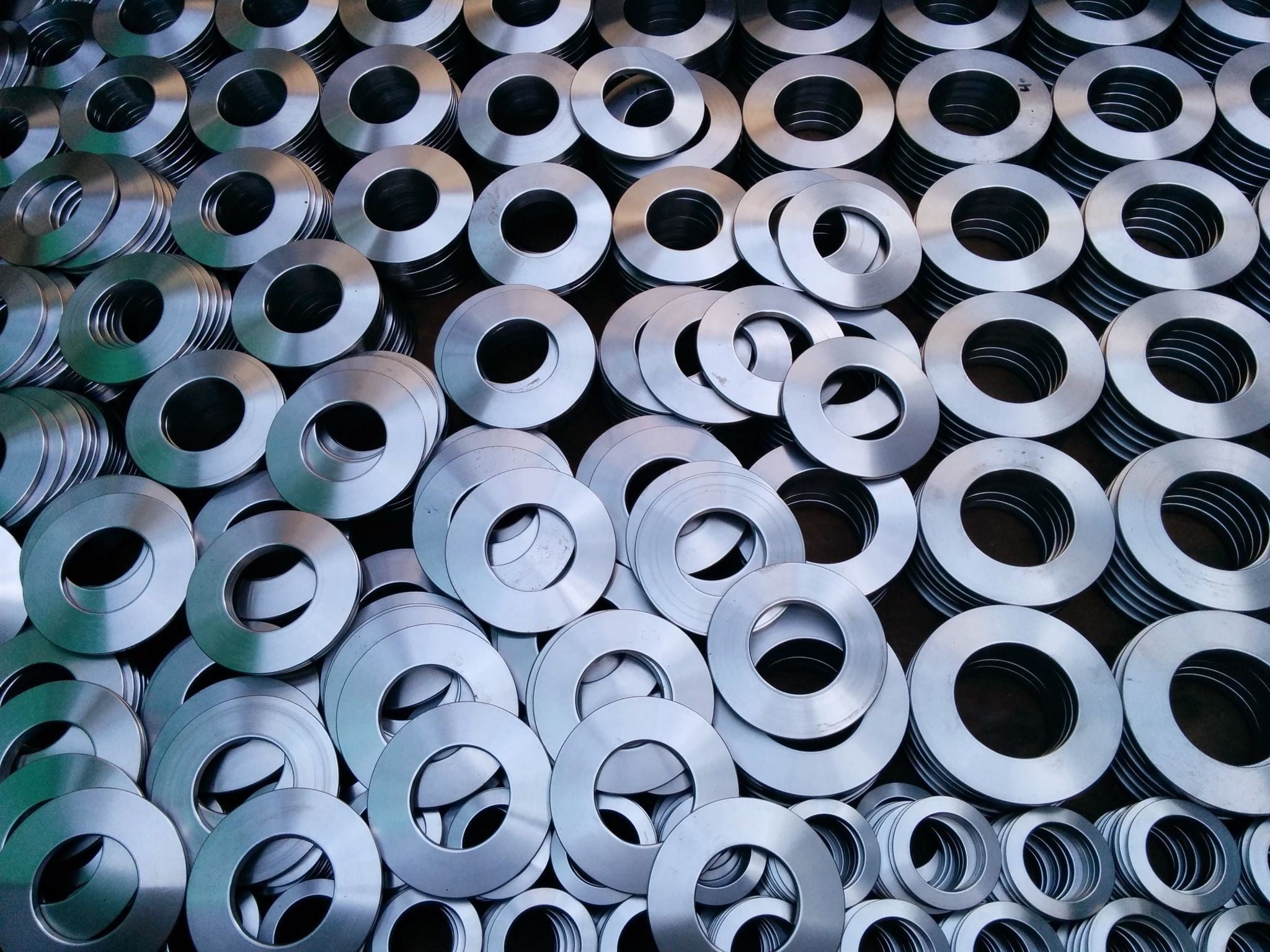
Choosing the right disc spring for your application
Selecting the right disc spring depends on how much force the application demands, how much deflection it needs, and how much space is available.
For most applications, a single disc spring provides precise load over a short deflection range. Where greater travel is needed at the same force, disc springs are stacked in series. Where higher load capacity is needed, they're stacked in parallel. Combination stacks fine-tune both, and slotted disc springs offer a softer spring rate where controlled flexibility matters – as in clutch diaphragm springs.
Beyond configuration, the operating environment drives material choice. Spring steel is ideal for general use, stainless steel suits corrosive or high-humidity conditions, and superalloys are best for extreme temperatures.
Whatever your application needs, our engineers are on hand to advise on the best solution to meet your performance and cycle life requirements.
Stock and custom disc springs from Lesjöfors
From clutch assemblies and brake calipers to hydraulic valves and wind turbines, disc spring applications share one demand: reliable force in minimal space, sustained over millions of cycles. At Lesjöfors, we manufacture disc springs proven in exactly these environments – supplying stock Belleville springs for immediate availability and custom spring designs engineered to your application's load, deflection, and environmental requirements.
With thicknesses from 0.10 to 12 mm, outer diameters up to 500 mm, and ISO-certified production, we deliver the same component quality whether you need one prototype or an OEM production run.